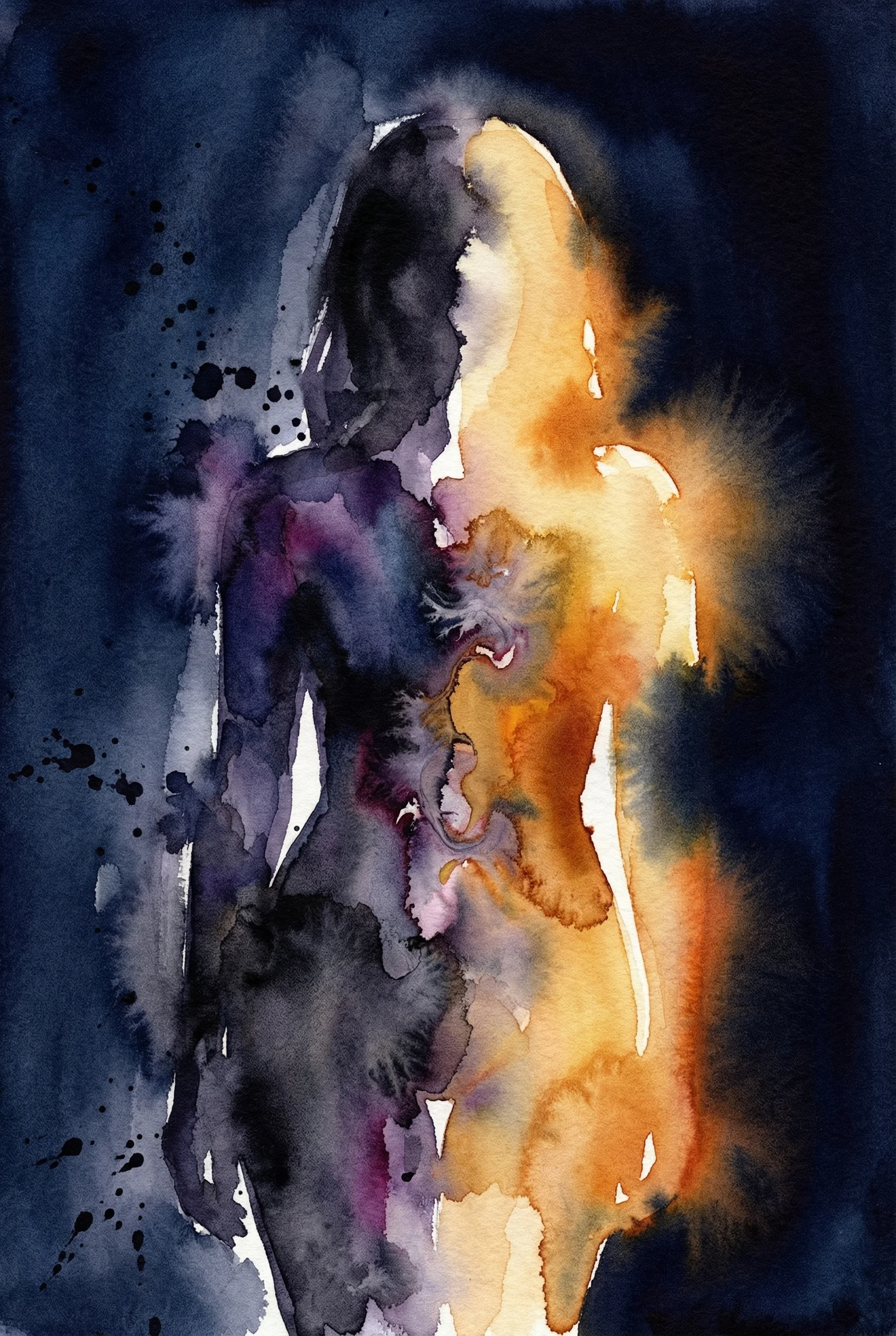
What is shadow work, really?

Shadow work is the practice of intentionally uncovering and reclaiming parts of yourself that you’ve pushed away. The emotions you learned to swallow. The impulses you trained yourself to override. The traits that someone once told you were “too much.” The goal isn’t to fix yourself. It’s to stop spending so much energy holding pieces of your identity at arm’s length.

The term comes from Carl Jung, who used “the shadow” to describe everything about ourselves that we refuse to acknowledge. Jung introduced the concept in the early 20th century as part of his analytical psychology framework, describing it as the unconscious aspect of the personality that the conscious ego doesn’t identify with. But as a lived practice, shadow work goes far beyond Jungian theory. It’s the unglamorous daily work of noticing the parts of you that flinch when someone gets too close, or go quiet in a meeting, or explode over a small comment at dinner.

Your current identity is the version of yourself you feel safe expressing, the one you let people see. Your shadow self is everything else. The parts still living in your body whether you acknowledge them or not.

I spent years thinking shadow work meant becoming a better version of myself. It doesn’t. It means stopping the performance of being someone incomplete.

When those two halves operate separately, your nervous system works overtime. It has to track which parts of you are “safe” to show, which need to stay hidden, how to numb the ones that keep trying to surface. That takes enormous energy, and it’s energy your body could be spending on sleep, on hormone regulation, on actually being present in your relationships.

Shadow work is the slow process of letting those halves reintegrate. It won’t happen all at once, and it won’t happen perfectly. But it can happen intentionally.

How your shadow self forms (and why shame is the engine)

Your shadow self doesn’t appear out of nowhere. It’s built, piece by piece, through shame.

Shame is what teaches you which parts of yourself are dangerous to express. Not actually dangerous, but dangerous to your survival as a child who depends on love and belonging to stay alive. When you get shamed for a natural impulse (being “too emotional,” too loud, too needy), your nervous system records a clear message: this part of you threatens your access to safety.

So you suppress it. An internal critic develops that sounds a lot like whichever adult delivered the original message. Over enough years, that critic stops sounding like someone else. It starts sounding like you. That’s the part that makes it hard to untangle.

Abstract watercolor of tangled threads loosening into golden light, representing the unraveling of shame

When the body remembers what the mind forgets

A girl I know — I’ll call her Mia — was told in fourth grade that she was “too emotional.” She cried when a classmate was cruel to another kid. Her teacher pulled her aside and said, “You need to toughen up. The other kids don’t do this.” Her parents, wanting to help, echoed the message at home: You’re too sensitive. You need thicker skin.

So she built thicker skin. She stopped crying in public. She learned to swallow the lump in her throat. By high school she was the “chill girl” who never made a scene. She was proud of it.

It took her until her late twenties to realize that her sensitivity, the thing she’d been shamed for, was actually one of her greatest capacities. She could read a room. She could sense when someone was hurting. She could feel things deeply enough to respond with real empathy. She hadn’t outgrown any of that. She’d just buried it under fifteen years of performing indifference.

When she reclaimed that part, her relationships changed. She stopped attracting people who needed her to be “low-maintenance.” She started attracting people who actually valued her depth.

That’s what shadow work looks like from the outside. You don’t add anything new. You recover what was already there.

The mind-body connection most people miss

Most people treat shadow work as purely psychological. It isn’t. Your body keeps score whether you want it to or not.

Suppressed emotions don’t sit quietly somewhere in your subconscious. They show up as tension, pain, and physical patterns that doctors can’t always explain with bloodwork.

A woman I know had chronic tension headaches for years. She’d tried new pillows, screen-time limits, prescription medication, physical therapy. Nothing stuck. When she started processing the suppressed anger she’d been carrying since childhood, the headaches nearly disappeared. Same sleep schedule. Same diet. The only thing that changed was her relationship with the emotion she’d spent decades clenching her jaw against.

This isn’t woo. Research backs it up. Dr. James Pennebaker at the University of Texas at Austin found that writing about suppressed emotional experiences for just 15–20 minutes a day over four days led to measurably improved immune function and roughly 50% fewer health center visits in the following months. Neuroimaging research from UCLA has shown that expressive writing activates the prefrontal cortex while dampening activity in the amygdala, our threat detection system. Chronic suppression creates chronic stress, and chronic stress has real downstream effects: disrupted sleep, hormonal imbalance, inflammation, digestive issues. Your body and your emotions are not separate systems, no matter how much we’ve been trained to treat them that way. When you stop spending energy holding yourself in fragments, that energy becomes available for actual regulation and repair.

Shadow work won’t cure a medical condition. But if you’ve ever had a physical symptom that no treatment fully resolved, it’s worth sitting with the question: What am I holding in my body that I haven’t let myself feel?

Ready to start exploring your inner world?

Imago is an AI-guided shadow work journal that helps you meet the parts of you that have been waiting.

Download on the App Store

The 5 phases of shadow work

Shadow work isn’t a single technique. It moves through distinct phases, and you don’t complete one and never return to it. They’re more like territories you revisit as deeper layers surface. But knowing the map helps you recognize where you are when the terrain gets confusing.

Abstract watercolor pathway with five glowing waypoints graduating from teal to amber

Phase 1

Embodied nervous system education

You can’t work with your shadow if you don’t understand how your nervous system actually operates. This first phase is education: learning to recognize your shame patterns, understanding enough developmental psychology to identify where your shadow parts likely formed, building somatic awareness. No deep emotional excavation yet. You’re building the container that makes the deeper work safe enough to attempt.

Phase 2

Shame detoxing

If shame is what drives suppression, then de-shaming is what drives shadow work. Here you start making unconscious shame conscious. You map your explicit shame (the things you know you feel ashamed of) and your implicit shame (the deeper, older patterns you don’t even recognize as shame yet). You learn what shame actually feels like in your body, not just in your thoughts. And you start practicing vulnerability in safe spaces. Vulnerability is the direct antidote to shame, but it only works if the space is genuinely safe.

Phase 3

Self-attunement

If you’re carrying a lot of shame, your default is to attune to everyone else first. Reading the room, anticipating needs, placing other people’s comfort above your own. Phase three flips that. Can you check in with yourself before checking in with others? Can you notice what you actually want, what feels like a yes, what feels like a no? For a lot of people, this is the phase where they realize they’ve been outsourcing their compass for years.

Phase 4

Reclaiming self-expression

This is where it gets messy in a good way. You’ve built some safety, processed some shame, started listening to yourself. Now you experiment with actually expressing the parts you’ve kept hidden. Saying the thing you’d normally edit. Trying something you’d normally talk yourself out of. It’s uncomfortable and sometimes exhilarating and you will get it wrong sometimes. That’s part of it.

Phase 5

Forward integration

The first four phases are mostly retrospective: working with what happened to you, unpacking childhood patterns, processing old emotions. Phase five faces forward. Instead of healing where you’ve been, you start using shadow work to support where you’re going. At some point it stops being a thing you sit down to do and becomes more like a way you move through your life.

What changes when you do shadow work

The changes aren’t abstract. They show up in your actual life.

The most immediate shift is in your reactions. Someone says something that used to send you spiraling, and this time you notice the activation before it swallows you. The pause between trigger and response gets a little longer. Then a little longer than that.

Relationships get more honest, sometimes uncomfortably so. You stop performing the version of yourself that keeps everyone comfortable, which means some people won’t like the change. But you also start attracting people who actually want to know you, not the curated version.

Physical symptoms often ease. Jaw clenching, insomnia, tension that no stretching routine could touch. A systematic review and meta-analysis published in Family Medicine and Community Health found that journaling-based interventions significantly reduced symptoms of anxiety, depression, and psychological distress across over 200 studies. Regular expressive writing has been shown to reduce cortisol levels by up to 23%. There’s something that happens in the body when you stop holding yourself in fragments.

And the patterns that used to run on repeat, the same argument with every partner, the same self-sabotage at every threshold, those become visible enough that you can finally make a different choice. Self-compassion stops being an affirmation you recite and starts being something you actually feel toward the parts of yourself you used to judge hardest.

Mostly, energy comes back. Maintaining a split identity is exhausting work, and when you stop doing it, you get that energy back for everything else.

How to actually get started with shadow work

If you’re reading this far, you’ve probably already started. Being curious about your patterns is shadow work. Noticing that some of your reactions don’t match the situation is enough to begin with.

Start with journaling

Shadow work journaling is the most accessible way in. No therapist, no group, no certification. Just a quiet space, an honest pen, and the willingness to write what you normally wouldn’t say out loud. Prompts help, especially early on, because a blank page invites your defenses to write instead of you. (We put together 75+ shadow work journal prompts organized by theme.)

Pay attention to your triggers

When a wave of anger or shame or anxiety hits and it’s clearly bigger than the situation warrants, you’ve probably hit a shadow part. Don’t try to analyze it in the moment. Just notice. Write it down later.

Get curious about your inner critic

Whose voice is your inner critic actually using? When you tell yourself you’re “too much” or “not enough,” who said that first? Tracing the origin of your self-talk is one of the most direct paths into this work.

Make it regular, not intense

Five minutes of daily reflection builds more awareness than a single two-hour deep dive every few months. Just checking in with how you feel, noticing which “part” of you is loudest that day. The awareness accumulates.

A daily shadow work practice in your pocket

Imago combines AI-guided journaling with IFS-informed parts work to help you build a shadow work practice that sticks.

Download on the App Store

Frequently asked questions

Is shadow work dangerous?

Not inherently, but it can surface intense emotions, especially if there’s unprocessed trauma underneath. The important thing is pacing. Start with lighter material: recent triggers, mild frustrations, surface-level patterns. Don’t try to excavate core wounds in your first week. If you have a history of trauma, PTSD, or dissociation, doing this work alongside a therapist is a good idea. The litmus test: shadow work should feel challenging but leave you with more awareness, not less stability. If you consistently feel worse after, that’s a sign to slow down.

Do I need a therapist to do shadow work?

No. Plenty of people do meaningful shadow work through journaling and self-reflection without ever sitting in a therapist’s office. But they work well together. A therapist provides relational safety that’s hard to create alone, and a daily journaling practice gives you a space to process between sessions. Different tools, same project.

How long does shadow work take?

It’s not something you finish. Some people notice real shifts in the first few weeks of consistent journaling: less reactivity, more self-awareness, better sleep. Deeper patterns can take months or years to fully unwind. The timeline honestly matters less than whether you keep showing up. Five minutes a day will get you further than one intense workshop every six months.

What’s the difference between shadow work and therapy?

Therapy happens with a trained professional in a clinical setting. Shadow work is broader: you can do it on your own, in community, or alongside therapy. Some therapeutic modalities, particularly Internal Family Systems (IFS) and somatic experiencing, are essentially structured shadow work with professional guidance. The real difference is context: who’s holding the container, and what kind of support you have when hard things surface.

What is IFS and how does it relate to shadow work?

IFS (Internal Family Systems) is a therapeutic model developed by Richard Schwartz, Ph.D. in the 1980s. It was listed on the National Registry of Evidence-based Programs and Practices (NREPP) in 2015, rated as “effective” for improving general functioning and well-being. A 2021 pilot study of IFS for adults with PTSD and childhood trauma found that 92% of participants who completed treatment no longer met diagnostic criteria for PTSD after 16 weeks. IFS maps your inner world as a system of “parts” (protectors, exiles, and firefighters) all orbiting a core Self. The shift from “I’m anxious” to “A part of me is anxious” sounds small, but it immediately creates space between you and the emotion. That space is where the work happens. Imago is built on this framework.

Can shadow work help with anxiety?

It can, and often does. A lot of what we experience as “anxiety” is the nervous system’s response to internal fragmentation: when you’re constantly suppressing parts of yourself, your system stays on alert. Shadow work gets at the underlying pattern instead of managing the symptom. If you experience clinical anxiety, though, treat shadow work as a complement to professional treatment, not a substitute.
